

timeline of this story #2: the turning
The tiniest scrape exposes the fragility of it all: any of my ‘achievements’ are so complex they are sullied — each ‘success’ might be more accurately defined as a composite of failures.

When I was trying to become a professional basketballer, I asked a psychologist: when exactly does self-belief become self-delusion? He laughed like I had made a funny joke and I was pleased by his amusement but I was also serious.
The definitions feel absurdly and dangerously close to each other:
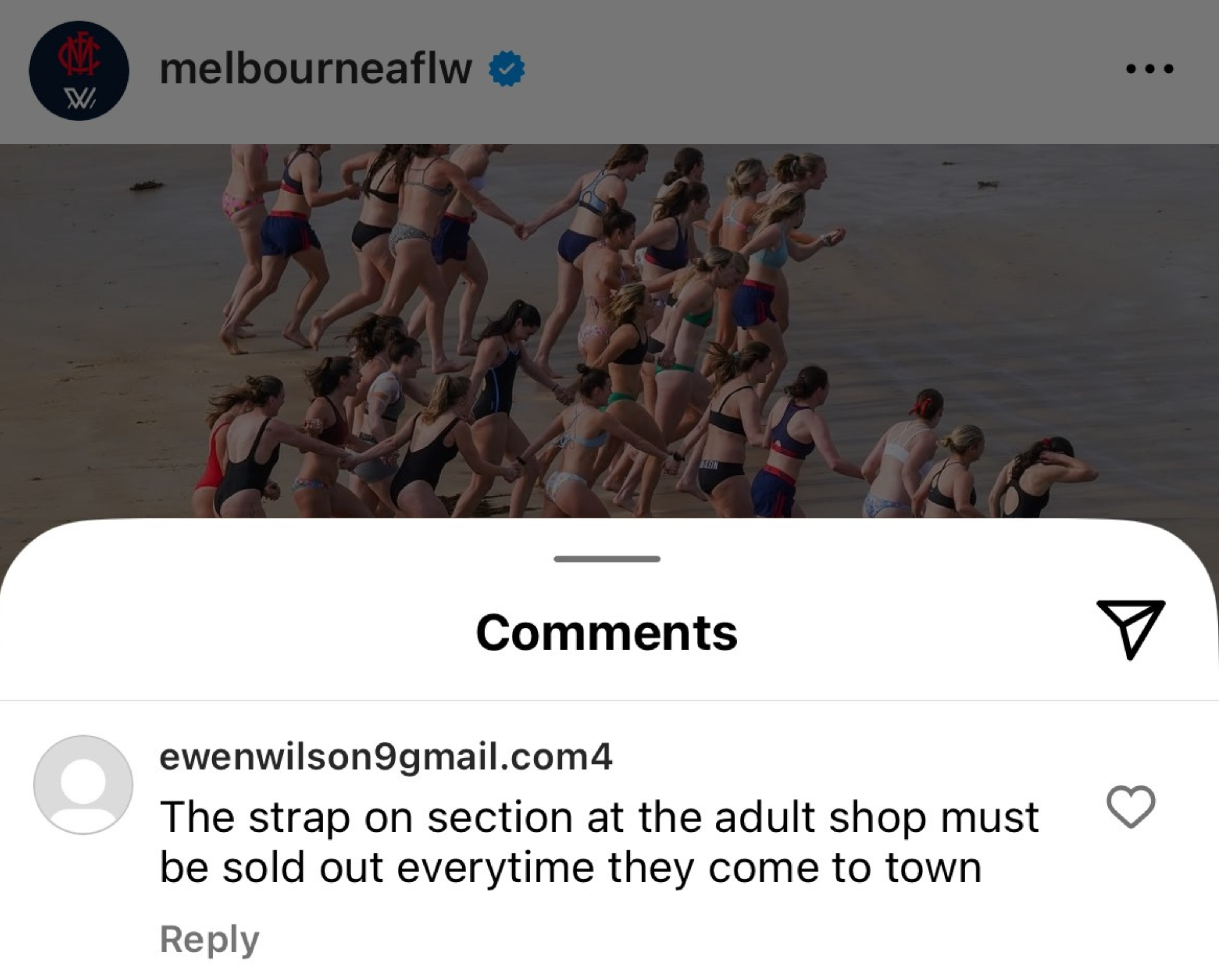
self-belief
noun
/ˌself.bəˈliːf/
confidence in one’s judgment;
belief in one’s capacity to complete a task or achieve a goal;
trust in one’s own abilities.
self-delusion
noun
/ˌself.dɪˈluː.ʒən/
a process of denying or rationalising away the relevance, significance, or importance of opposing evidence and logical argument;
the act of allowing oneself to believe something that is not true;
the state of deceiving oneself about one’s abilities.
I consistently allow myself to believe in my capacity to achieve [a goal] — a reality that does not currently exist and can therefore be categorised as something that is not true. I have confidence in my judgment of this capacity, even when there is an abundant amount of opposing evidence. It seems probable that, to allow for the continued pursuit of the goal, I might be incidentally denying or rationalising away the relevance, significance, or importance of this evidence. I could be ignoring all logical arguments. I could be deceiving myself.
uh-oh
exclamation
/ˈʌˌəʊ/
an expression of alarm, dismay, or realisation of a difficulty.
I must, although it doesn’t always feel like it, have trust in my own abilities … but what is the difference between that and being utterly duped by my desires? It seems like the only difference is outcome, so am I just within the nebulous bracket of self-[belief/delusion] until the outcome comes out? Or do I assume self-belief until the goal is un/attained and my ability is dis/proven, at which time I can then either confirm my mental fortitude or sheepishly acknowledge that my aspirations were misguided and unrealistic?
What if the outcome takes a while? What if the outcome takes more than a while? When is the logical expiration date of belief that prompts the transition from self-[undefined] into pure, rigorous, inescapable delusion?
The biography on my website states,
‘Each of [my] careers have hauled themselves forward in parallel: demarcated consistently, enduringly, by failure.’
Nobody, even the luckiest, whisks through their life without encountering failure. But the quantity of that failure, depending on circumstance and character, varies drastically. As someone who has, if there was a scale, been nursed by experiences closer to the threshold of you suck than wow, you’re great, I fear I have naturally also been treated to larger doses of delusion. Am I resilient or obtuse? Humble or narcissistic? Gallantly ambitious or farcical?
When exactly, I said to the psychologist, does self-belief become self-delusion? and it was posed in the context of me pursuing a basketball career, but it could be as easily applied to any realm of my life, including as a writer.
I concluded the only reason I have been able to persist in art and sport is because I am a contradiction:
I have such a big ego it allows me to keep going (I believe I can be good enough);
I have such a small ego it allows me to keep going (I can tolerate constant rejections because I assume I am not good enough).
In a lot of ways, I am accustomed to not succeeding. It is familiar to me; it secretly makes sense. There might be some who snort at that, because I am signed to a professional sporting team, or I’ve worked with photographers, or it’s reported I have a book contract, but the tiniest scrape across the coruscation exposes the fragility of it all: any of my ‘achievements’ are so complex they are sullied — each ‘success’ might be more accurately defined as a composite of failures.
I use the word failure to describe my current self sometimes and friends flinch in condemnation and pat me on the shoulder. But failure is not an ugly word.
The art I have created, that has sought and eventually been granted permission to enter the world, are composites: even after their acceptance, the pieces remain tinged with the rejections they have accumulated.
I find myself returning to the notions of resilience and shame, of belief and delusion, of success and failure. I am drawn to the journey of art being art itself. It feels like not preserving, or at least drawing on, these journeys in some way causes cavities within the fuller dialogue. It carves out an absence, blunts nuance.
This is a protracted way to introduce a new little series called tots — timeline of this story that maps the life of a creative project before its release: from conception through submission cycles. An early incarnation of the series was published in December 2021, although the story was not a physical work but an entire year.
I opened the essay with a recalcitrant apology:

I repeat, and intensify, the apology for tots #2 which explores the journey of the turning, an essay about women and sport. Its timeline is gruelling and boring and truly, hilariously, mortifying. That is your warning.
Timeline Of This Story: the turning
2020
3 october, 2020 | 11:18am
I wrote down: to be turned, to be preyed upon, to alter, to conquer verse a change in direction, an evolution, new growth or understanding, shaping or becoming, expansion.
16 october, 2020
I spent an entire day finishing a narrative non-fiction book proposal named The Turning for the Spark Prize. I submitted it at 11:47pm.
‘It seeps through us in fractures: as a phenomenon, a myth, a joke, an enduring stereotype, a revolution. A question that has lost its form, is no longer a question but an implication: Do women turn gay in sport?’

I thought: I think this might win.
3 december, 2020
It did not win.
2021
21 february, 2021 | 10:04am
Following an interesting conversation with a teammate, I wrote down: literary magazine article? called ‘the turning’?
In the same note, I wrote a few thousand words. The world is so much more complicated than binary.
19 march, 2021
I decided to submit a non-fiction pitch called The Turning: is sexuality actually contagious in female sport? to Kill Your Darlings, a literary magazine about arts and culture. I first had to learn how to write a non-fiction pitch.1
Why this piece? prompted the KYD pitch template. Why you? Why are you the best person to write this piece? Why do you care about the topic? Why should the editor care about it? Why should readers care about it? What questions or insights are you wanting to convey? Why is it a good fit for the magazine? Why is now the best time to publish it?
‘This topic is both encompassing and nuanced,’ I wrote, ‘and has a vocal, hungry audience now. More than ever, women and young girls are participating in physical activity; infiltrating what was once staunchly male-only spaces. Historically when there are pushes for equality and inclusion, resistance manifests in a myriad of ways. That is why this piece fits neatly into what Kill Your Darlings publishes: the magazine does not shy away from contentious societal critique, nor uncomfortable conversations. It consistently, unflinchingly challenges.’
I thought: wow. I am excited to write the essay when this pitch is obviously accepted.
21 april, 2021
The pitch was not accepted.

I spent the rest of the year busy.
2022
13 march, 2022
I edited the pitch and submitted to KYD again.
‘This topic is an urgent one: not only are we finally celebrating #womeninsport, we are being forced to interrogate how far our tolerance for difference stretches — and where the lines of our inclusion is drawn. Kill Your Darlings is an unflinching magazine that is prepared to facilitate these kind of conversations, and it is a big goal of mine to be included in its writer alumni.’
25 march, 2022
KYD said: maybe we do not want you in our writer alumni.
I said: I really want you to be sure.
29 may, 2022
I re-edited the pitch, lost the two capital letters when paring the title back to ‘the turning’ and submitted once more to KYD.
‘I continue to submit a variation of this pitch to Kill Your Darlings (sorry) because not only am I passionate about this topic, but I have not seen it engaged with deeply, nor offered creatively from the perspective of a woman who is both a writer and an athlete.’
15 july, 2022
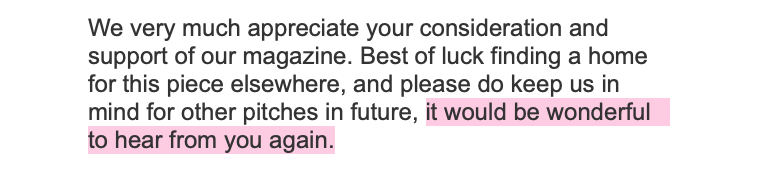
KYD said: apologies for the delay getting back to you.
KYD said: please do keep us in mind for other pitches in future, it would be wonderful to hear from you.
25 november, 2022
KYD announced their Creative Non-Fiction Essay Prize. For the first time, I expanded the pitch and wrote out an actual essay — 3,500 words of it.
turn [turn]
verb
to be altered, corrupted; to be conquered.
noun
a change in direction, a movement; a natural evolution or expansion, a becoming.
— and submitted it. I thought it was the best thing I had ever written: mature, biting. I also really thought it might win.

6 december, 2022
It really did not win.

2023
15 january, 2023
I then thought: okay, goodbye, KYD! and submitted an updated version of The Turning to the ABR Calibre Essay Prize.
‘The stereotype shimmers translucent, slippery: widely acknowledged and yet taboo, available as fodder for jokes but not as a topic for legitimate dissection on a cultural level. It is not intended to free us. It has always been about dominance.’
I, again, suspected it might win.
6 april, 2023
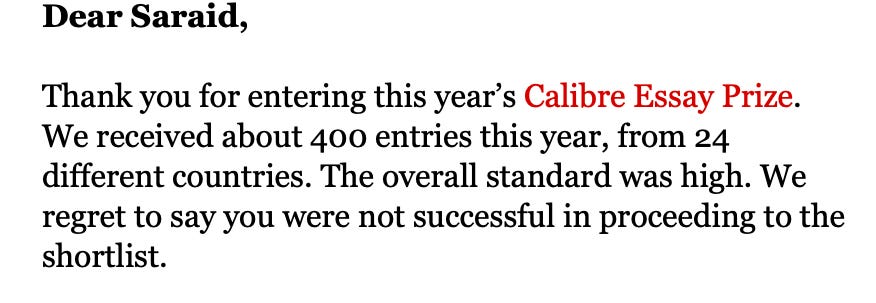
It, again, did not.
23 april, 2023
I thought perhaps the title was an issue and, humbly returning to KYD, revised the piece then submitted with a different name: The Politics of Women’s Sport.
The first line remained the same:
‘I was warned about the pandemic: of dangerous, contagious lesbianism. I rolled my eyes and dismissed it. I was heterosexual but cool.’
12 may, 2023
There was success.
Instead of the standard rejection message the piece had received from KYD three times: ‘This sounds like a unique angle on an interesting topic, but unfortunately it’s not the right fit for KYD at this time.’
KYD declined it with a different line: ‘This was a strong and interesting piece, but unfortunately in the end it wasn’t something we were able to fit into our schedule.’
Which felt downright personable. It could easily have been a new template for rejections, but I still thought: improvement! I thought: hope! I thought: this basically invites a follow-up query!
19 june, 2023
On the submission portal, there is a messages tab, which is where I sent back:
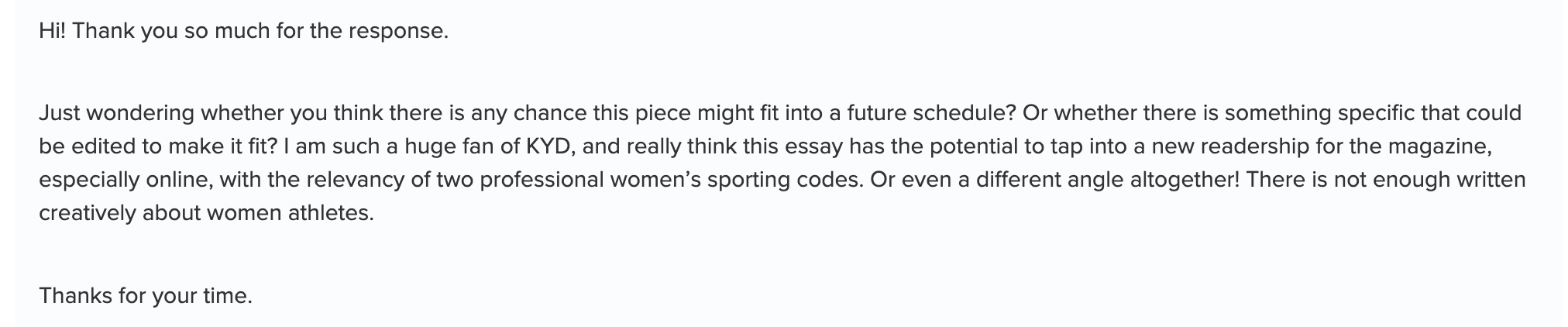
Shockingly, it did not receive a reply.
29 june, 2023
At a similar time, I had a relatively public online interaction with a famous ex-athlete. On the day I realised the editor of KYD now followed me on social media, I sent them a message:
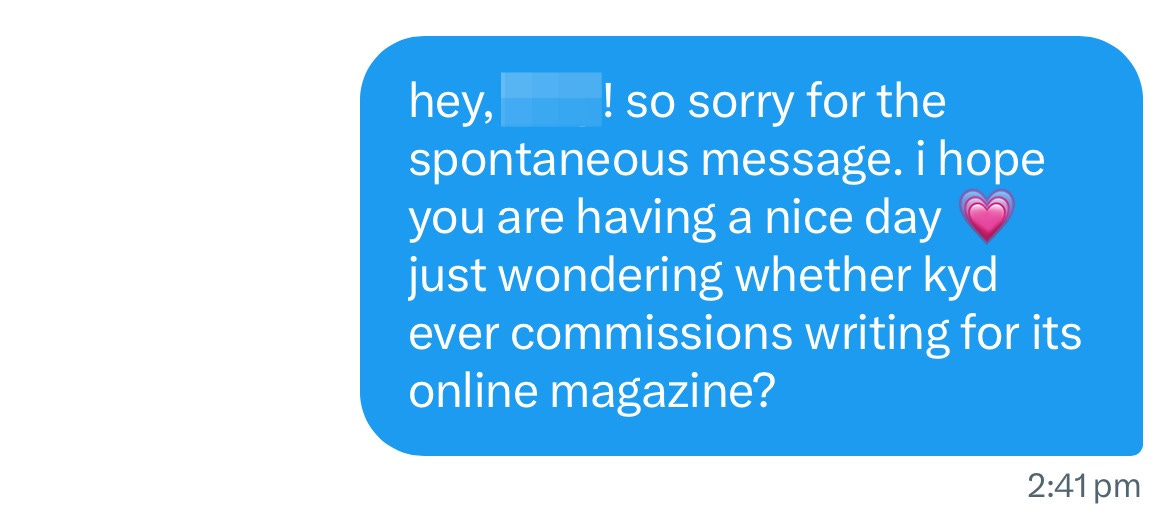
I readily admit I have absolutely no idea what I am doing. Are there rules, conventions, some secret but fundamental etiquette when it comes to pitching and submitting and persisting? Likely. Has anyone told me them? They have not.
The magazine’s editor courteously replied with:
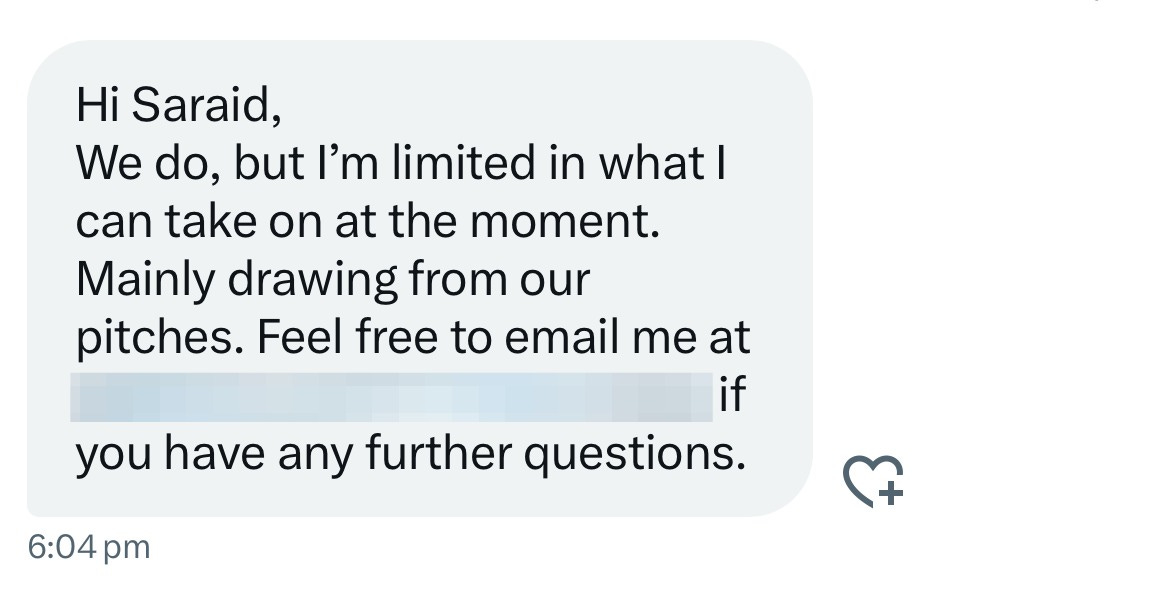
To which I said:
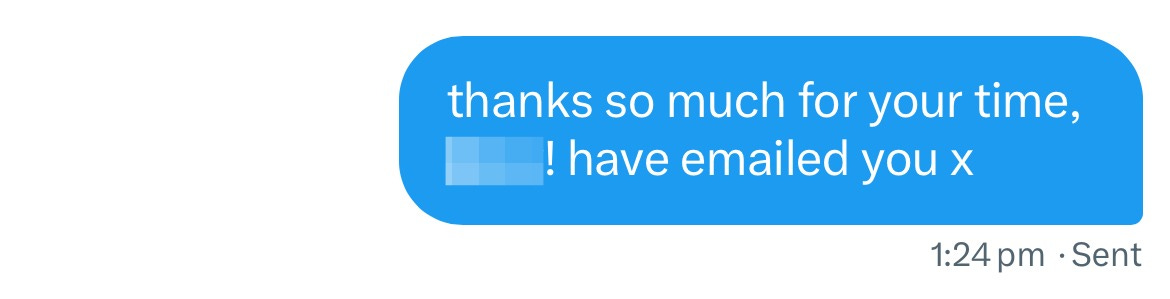
And then emailed:
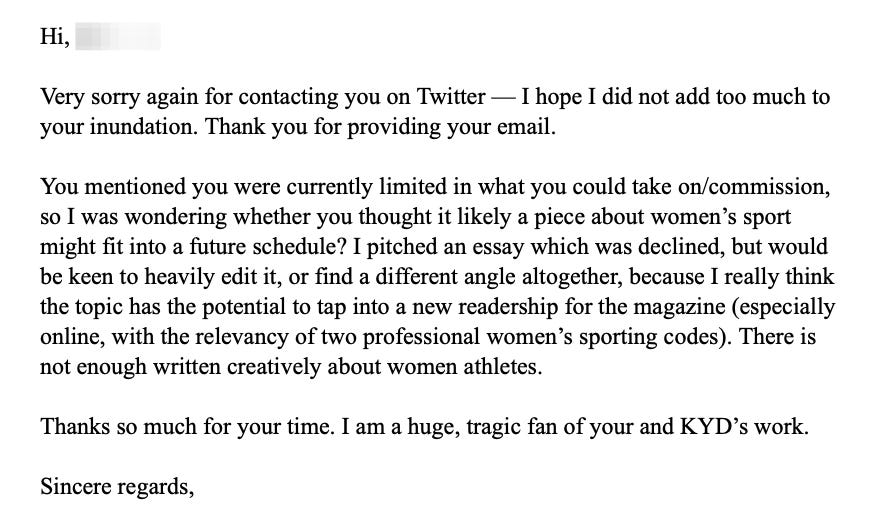
There was no reply.
I thought: fair enough. I thought: very sorry, please forgive me. I thought: it’s quite seriously now time to leave KYD alone.2
23 november, 2023 | 2:32pm
I left the essay alone too, for months, unsettled and saddened by its consistent failure, then I abruptly investigated Missing Perspectives, a media platform founded by
that challenges the underrepresentation of young women in news, and Archer, a print magazine about sexuality, gender and identity — edited the essay again, reinstalled its name, and sent it off to both.‘Please find below a summary pitch of The Turning: Sexuality and Shame in Women’s Sport, including a one hundred word bio, with the full draft also attached. It is longer than what you generally publish but I am hoping you might find an excerpt you like within it.’
5:09pm that day
An editor at Missing Perspectives replied:
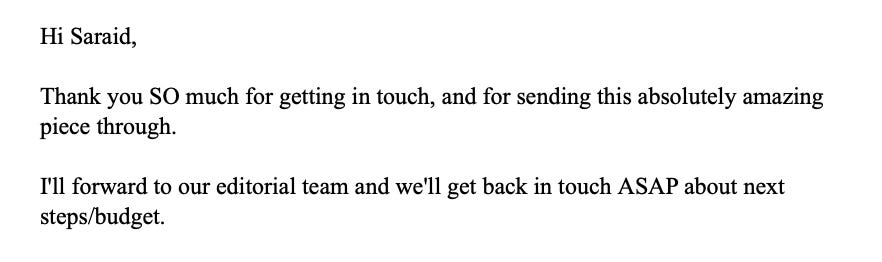
I emailed back as if I was nonchalant, and not giddy with surprise and joy.

24 november, 2023
They sent me the edited document.
As discussed, [the editors] reviewed and pulled an extract from the piece. They moved around a few paragraphs just to tighten it up, and can jump on the phone if you have any questions.
The essay had been chopped from 3,656 words to 1,929. Its tone — ruminative but irreverent — felt deadened. Its new opening line was: I accepted a contract with the Richmond Tigers in the AFLW last year.
It was my own fault for offering a strange little literary work to a news outlet. I closed my laptop in panic, feeling like I might cry.
27 november, 2023 | 10:07am
The Missing Perspectives editor emailed me again:
Hope you had a lovely weekend! We have our sports newsletter going out on Thursday so let me know what you think re: having an excerpt in the upcoming edition?
2:52pm
Damp with guilt, I sent back:
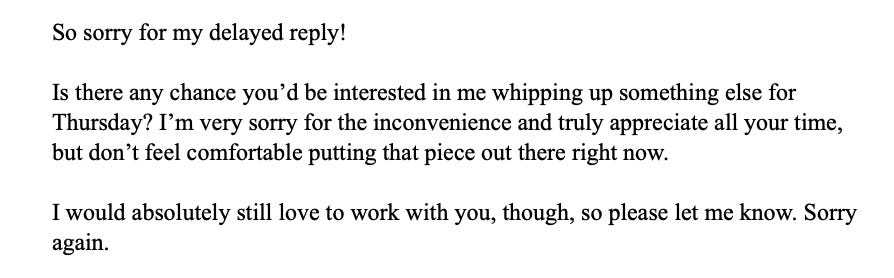
The editor was very gracious: No problem at all, they said, totally understand! Would love an op-ed — but no pressure either way.
3:48pm
I tweaked the essay, paid $2.50 USD and submitted it to an American literary magazine called The Sun.

4 december, 2023
One of Archer’s online editors emailed me.
Thanks so much for your draft! I’ll be working on this piece with you. Very excited about it!
Before I start on my edits, would you please be able to see if you can cut the existing draft to approximately 2000 words? I may then suggest more cuts from there, but I find that this process works best if the author makes their cuts first. Once you’ve had a go, it’d be great if you could send me the updated version … and we can go from there.
I reflected: I did essentially propose cutting it in half. I reflected: I’m not, however, sure I fancy cutting it in half. I reflected: I am unnerved.
2024
2 february, 2024
The Archer editor followed up:
Hope you’re well! No rush on my end (I’ll actually be on leave for the next few weeks), but I just thought I’d check in and see if you’d still like to continue with this piece?
To which I said:
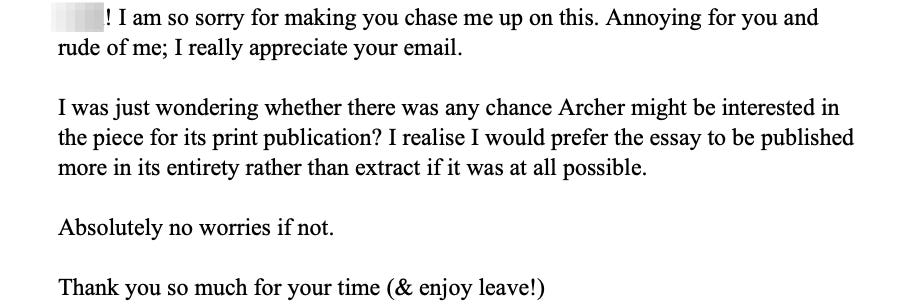
To which the editor responded:
No problem at all! Thanks so much for getting back to me.
I’ll have a chat with the rest of our team about considering this piece for print, but I can’t make any promises. And even with print, you may still need to make cuts to fit within our page layout.
But I’ll raise it with my team, and we’ll go from there.
the bts of the bst

Writing is a slow, sometimes secret, regularly lonely, process. It can feel, in phases, like being smothered — when pieces collect rejections; when they encounter an acceptance but the publication process is naturally protracted; when there is, ultimately, constantly, such limited artistic release. The amount of work being created is enormously disproportionate to the amount able to be shared.
13 march, 2024
The editor emailed back to say they’d discussed the piece with their team.
Although we all love it, we have limited space remaining for our next print issue, and a specific theme we’re prioritising.
I’d still love to work on it with you for online publication if you’re keen, but you’re also welcome to pitch it elsewhere if you’ve got your heart set on print. Totally fine and understandable either way!
Let me know what you think.
I replied:

They replied:
That’s not an annoying question at all! Thank you for asking. I’m not sure what our timeframe looks like for the issue after the next issue, so my main concern would be making you wait a long time on something that I can’t promise at this stage. How comfortable would you feel waiting (potentially until the end of the year) for a decision on whether we could pick it up for print?
I thought: the end of 2024! That does sound like a long time away.
25 march, 2024

I encountered a print magazine called RUSSH, which publishes both written and visual art, and submitted a piece of fiction to their Literary Showcase, and then emailed them an updated version of The Turning as a nonfiction submission.
As for supplied imagery, I wrote, if you’re interested in this piece, I could organise a portraiture shoot with a combination of other athletes, exploring physicality verse gender verse sexuality.

28 march, 2024
The essay received a rejection from The Sun.
3 april, 2024
Island, a literary magazine based in Lutruwita/Tasmania, opened for their online submissions and I edited The Turning and sent it in.
14 april, 2024
I apologised to the Archer editor for my late reply, then said:
I completely understand [there being no promises], and appreciate your concern / communication. I am happy to wait and see how we go, especially as I would love to pitch a portraiture series … to accompany the piece if that is something the magazine might also be interested in.
15 april, 2024
The Archer editor said:
No worries about the late reply! I’ve popped your name and idea down for consideration in a future print issue of Archer. No promises on the outcome, but I’ll definitely discuss it with the team when the time comes. :)
22 april, 2024
I edited the essay and then submitted it, for $16.50, into the Island Nonfiction Prize 2024.

6 may, 2024
I received an invitation for the inaugural RUSSH Literary Showcase — self-described as a space for unrecognised writers - aspiring, emerging and established - to be supported in their dreams to write and be read — and replied to the email to say:
This sounds incredible — thank you for the invite. Any plans for a Melbourne-based event?
Which received a reply back:
Hi Saraid, so lovely to hear from you!
This is the first year we are holding the Literary Showcase … Hopefully in years to come we can continue this exciting initiative and hold the event in other states.
I naturally replied to the replier, who was also a photographer:
Yes, it really is such an exciting initiative bringing so many different art forms together — I unfortunately won’t be in Sydney on the day so hopefully the event does spread in coming years.
Also! I had a look through your photos; you are such a talent. They are absolutely stunning. Let me know if you’re ever in Melbourne! I’d love to work with you.
They replied:
Aw, thank you, that is so kind. I would love to head down to Melbourne more often and work with all the talented creatives down there; if I do I will hit you up.
I replied:
That would be so fun! Please do.
One last thing while I have you (very sorry!) — do you know whether RUSSH accepts unsolicited essays? The website says to email for more information about written submissions, so I queried in late March. Should I have received a response, or is it best to assume the piece has been passed on?
They replied:
.
(Nothing; they stopped replying.)
(I intuited the piece had been passed on.)
21 may, 2024
The shortlist of the Island Nonfiction Prize was announced. The Turning was not on it.
29 may, 2024
It was also not selected for Island Online.

2 september, 2024
It was then edited again and submitted to Island for its print round.
I thought: this is it.
8 september, 2024
I edited the original pitch and submitted it with two other ideas to GR Online — the virtual extension of Griffith Review, a literary quarterly journal.
I thought: this is also it.
19 september, 2024
It was not it.
(The essay was not commissioned by GR Online.3)
31 october, 2024
It was not it either.
(The essay was rejected by Island for its print round.)
I thought: oh! my! goodness!
I thought: is this essay not relatively bold? Is it not rather poignant? Is it not strangely funny in a sardonic kind of way? Why doesn’t anyone like it? Why doesn’t anyone see its remarkable, wondrous potential?
Then I thought: maybe I don’t even like it.
Then I thought: maybe it doesn’t have any potential.
Then I thought: hide it away forever.

27 november, 2024
Then I thought: okay, try again.
I followed up with the Archer editor.
Just wondering whether there was any potential update on the essay fitting into / being selected for an Archer issue? Absolutely no worries if not. Appreciate your time, and hope you’re having a nice Wednesday.
29 november, 2024
The editor replied:
I don’t yet have any updates about upcoming print commissions.
Our next print issue will likely be [redacted], and we’re not sure about the timeframe or theme for the next one at this stage. This will likely be decided next year, after February … If the wait and uncertainty is too much, that’s totally understandable — feel free to let me know at any point if you’d like to pivot this piece for online publication.
I fear that I, now officially imbedded inside the bracket of self-[delusion] despite all opposing evidence, was not keen to pivot.
4 december, 2024
I stumbled across the social media account of a beautiful print magazine, The Everywoman. On a recent piece, one of the editors was tagged. I did not have any dignity left anyway, so I messaged them.
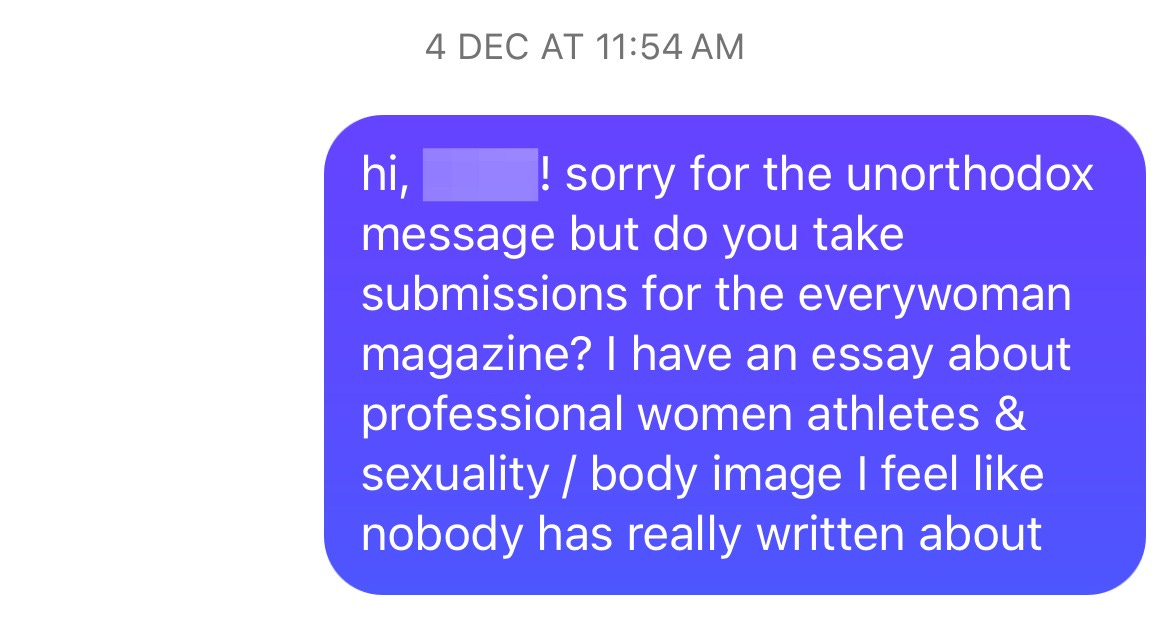
The editor replied:
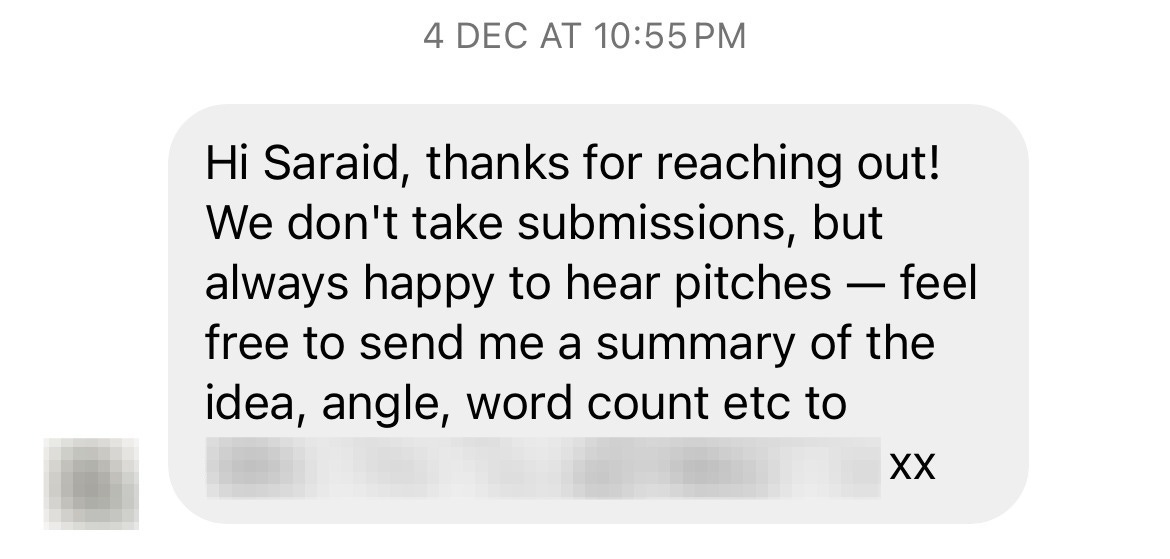
5 december, 2024
I emailed them:
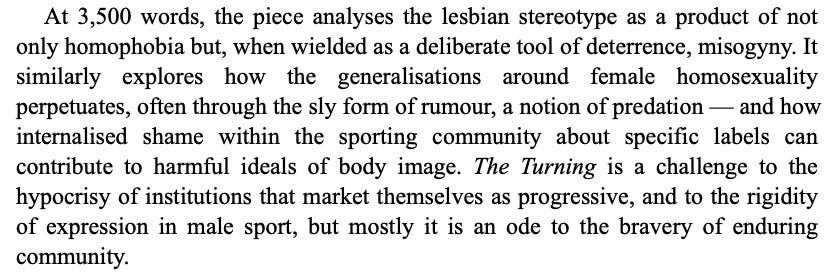

16 december, 2024
The editor emailed me back:
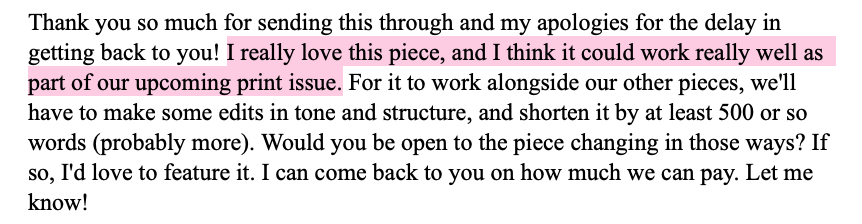
18 december, 2024
I replied:
Ah, that is exciting! Can I ask what kind of tonal and structural changes you’d be looking to make? If they’re vastly different, would it be easier for me to write something new on a similar topic? And yes, I’d love to know rate of pay please.
2025
13 january, 2025
The editor said: Apologies for my delay here, we’re just getting back on board with The Everywoman this week!
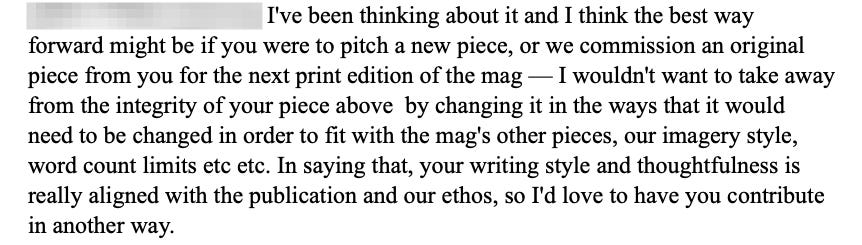
I said: That makes a lot of sense (and thank you for your thoughtfulness) — I’d be interested in either of those options.
25 january, 2025
I submitted The Turning to Splinter, a literary journal from Tarndanya/Adelaide.
5 february, 2025
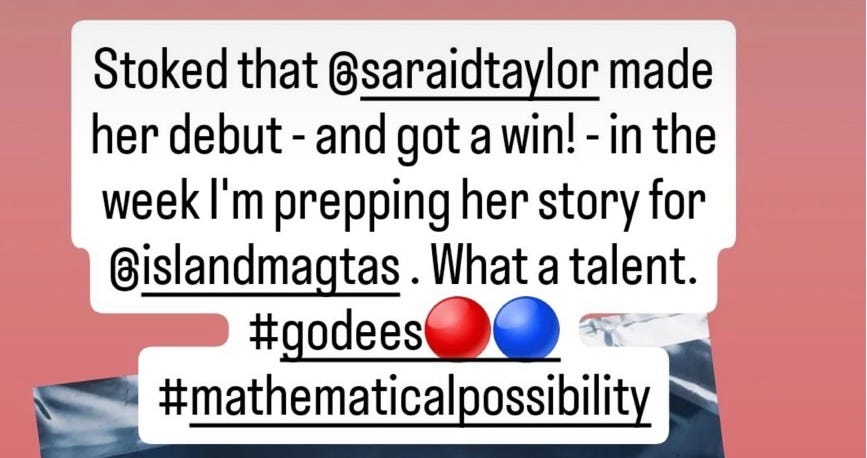
REWIND → In October of 2024, I worked with Island’s wonderful editorial manager, Jane Rawson. on a piece of fiction called the storing. That same month, I played my first professional game of AFLW and she tagged me in a story:
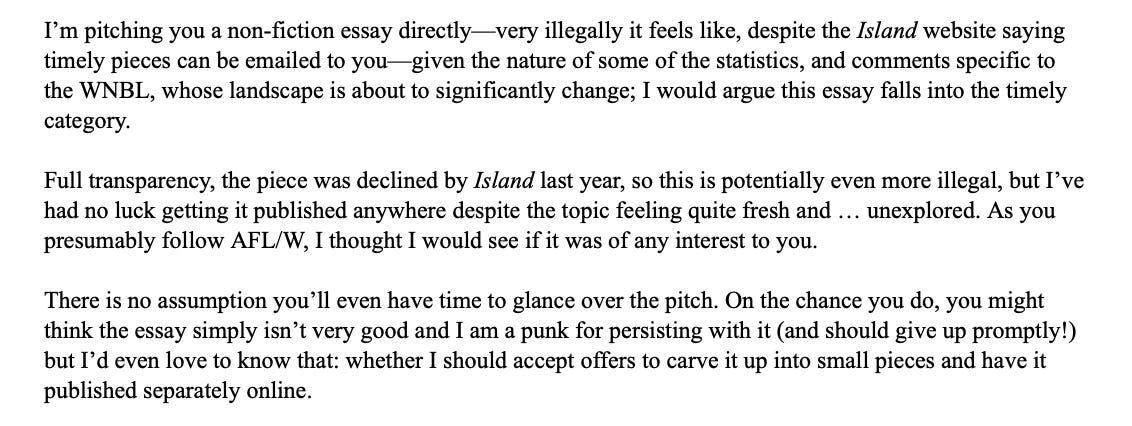
Four months later, after almost five years carrying the silly essay around in my body — being alternatively elated and poisoned by its prospects and failures — I had exhausted my supply of self-[belief/delusion] in it. Feeling genuinely a little manic, I snipped up the last surviving speck of my ego and, after poring over Island’s website, used the email it provided to contact the editorial manager personally:
3:29pm
5:12pm
Jane replied:

I sent back:

5:18pm
Island’s nonfiction editor, Keely Jobe, then emailed:

21 june, 2025
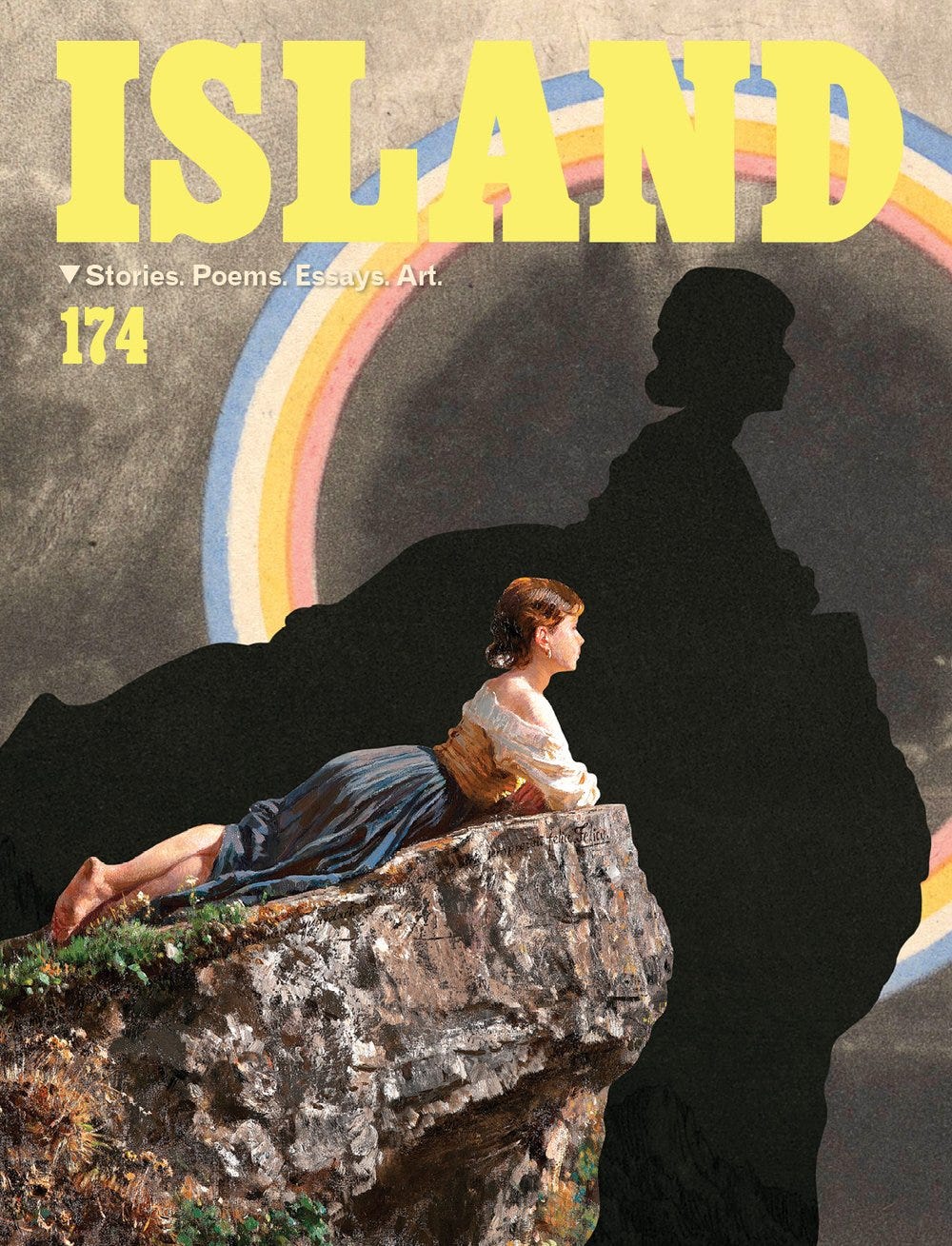
The Turning, after rounds of edits, was published as a 3,563-word essay in the print edition of Island 174.
26 june, 2025
I received this email abruptly from a stranger4:


Saraid Taylor trains and writes on sacred Wurundjeri country. She acknowledges Elders, past and present, and extends that respect to all First Nations peoples around the world.
Three organisations to support:
APAN — a national coalition harnessing the passion of Australians for Palestinian human rights, justice, and equality.
The Jewish Council of Australia — a diverse coalition of Jewish academics, lawyers, writers and experts on antisemitism and racism.
The Dhadjowa Foundation — a grassroots organisation established to provide strategic, coordinated and culturally appropriate support for Aboriginal and Torres Strait Islander families whose loved ones have died in custody.
A more important timeline to read:
I also had to pay $40 as submissions are only accepted from subscribers.
This is my formal apology to KYD. At least I continue to pay that membership fee?
working body was.
The stranger’s name is Dean Kiley. As I said, Dean: Thank you so sincerely for taking the time to send such generous praise to someone you don’t know. I will remember it.